Is a fibre laser welding machine just hype—or is it the real game-changer in precision welding?
When people think about welding, they often imagine sparks flying, bulky machines, and traditional methods like arc welding or MIG/TIG setups. But in the manufacturing world, those perceptions are being challenged—quietly but powerfully—by one tool: the fibre laser welding machine. This advanced equipment has carved out a place across industries not because it follows the old rules, but because it rewrites them entirely.

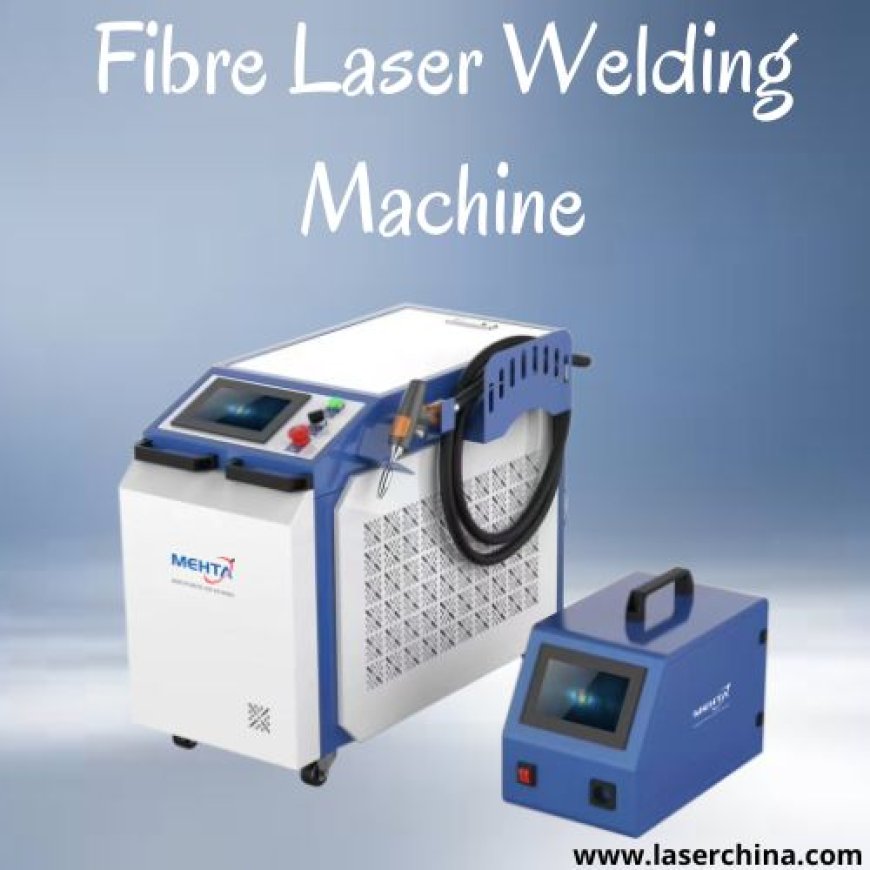
So, is the fibre laser welding machine just hype? Far from it. Its becoming the quiet force behind some of the most sophisticated fabrication processes in todays industrial landscape.
What Makes the Fibre Laser Welding Machine So Disruptive?
To understand the transformative potential of a fibre laser welding machine, you must first step into the shoes of a modern manufacturer. Precision, speed, energy efficiency, material compatibility, and consistency aren't just ideal featurestheyre business essentials. And this is where fibre laser technology delivers measurable impact.
Unlike conventional methods, fibre laser welding does not rely on consumables or contact-based heating. Instead, it uses a focused, high-intensity laser beam transmitted through a flexible fibre optic cable. The heat is directed with pinpoint accuracy, causing the metal surfaces to melt and fuse without filler materials in many cases.
This translates into a leaner processlean in terms of energy, effort, maintenance, and material waste. But lets dig deeper.
Why Industries Are Rapidly Shifting to Fibre Laser Welding Machines
Across sectorsbe it automotive, aerospace, electronics, defense, or precision medical devicesthe adoption rate of fibre laser welding is growing. This isn't a trend; it's a strategic shift.
Automotive: In an industry where the smallest defect can result in massive safety recalls, fibre laser welding is favored for its flawless joint quality. Its used in everything from battery trays in electric vehicles to intricate transmission components.
Aerospace: Lightweight materials like titanium and aluminum are frequently used in aircraft manufacturing. Traditional welding methods often fall short when dealing with these metals due to distortion and strength inconsistencies. Fibre lasers, on the other hand, offer clean and accurate welds with minimal thermal impact.
Medical: Cleanroom environments and the need for precision in device assembly make fibre laser welding ideal for surgical tools and implantable devices. The machines ability to deliver micro-welds without contamination is unmatched.
Electronics: As consumer electronics get smaller and smarter, internal component welding requires surgical precision. Fibre lasers can weld tiny connectors and sensors without damaging sensitive surrounding areas.
This cross-industry penetration is proof that the fibre laser welding machine is not just a niche innovation but a foundational tool that can be integrated into almost any production environment.
Real-World Production Impact
Take, for example, a mid-sized manufacturer of stainless steel kitchen equipment. Before integrating fibre laser welding, their process involved manual TIG welding, which was time-consuming, labor-intensive, and left room for operator error.
Upon adopting a fibre laser welding machine, they reported the following after just six months:
-
Cycle time reduced by 40%
-
Operator fatigue reduced to near zero
-
Post-weld clean-up practically eliminated
-
Aesthetic improvement led to increased market demand
This shift didn't require hiring new engineers or retraining the entire staffjust a modest upskilling initiative. Thats the kind of upgrade that doesnt just improve productionit transforms it.
Precision Meets Intelligence
Modern fibre laser welding machines are often paired with intelligent control systems. With real-time monitoring, auto-calibration, and software-assisted weld path planning, the margin for error reduces to negligible levels.
Smart sensors analyze joint quality during the weld itself, allowing for automatic adjustments. That means fewer defects, higher throughput, and reduced reliance on post-production inspections.
Imagine a production line where the machine not only performs the weld but also confirms its structural integrity in real time. Thats not future tech. Thats a fibre laser welding machine operating today.
Environmental and Operational Efficiency
Manufacturers are under increasing pressure to reduce their carbon footprint and operational costs. Fibre laser welding systems support both objectives.
Because the beam is so focused and energy is not wasted in radiating heat, the process is energy-efficient. It requires minimal shielding gas and produces virtually no spatter or fumes. This makes it safer for workers and more sustainable for the planet.
Additionally, the maintenance requirements for fibre lasers are far lower than for CO? or Nd:YAG laser systems. No need for constant realignment or replacement of mirrors and lensesfibre systems are solid-state and built to run continuously with minimal oversight.
From Batch Jobs to Full Automation
Whether you're running small-batch prototyping or high-volume assembly, the fibre laser welding machine can scale to meet demand. For small operations, handheld models exist that offer versatility without sacrificing performance. For large factories, integration with robotic arms and CNC systems allows for full automation.
This flexibility means that businesses no longer need multiple machines for different tasks. One fibre laser system, with different heads or setups, can manage a range of materials, thicknesses, and geometries.
In terms of ROI, this is critical. Instead of investing in separate setups for steel, aluminum, and brasscompanies are now choosing a single, adaptable solution.
Global TrendLocal Impact
The global demand for fibre laser welding machines is rising sharply. Asia, particularly China and South Korea, is leading in adoption due to high demand in consumer electronics and automotive manufacturing. Europe follows closely with applications in aerospace and precision tooling. In North America, automation in heavy industries like shipbuilding and defense is fueling the trend.
Locally, smaller fabricators are starting to follow suit. As entry-level models become more affordable and training more accessible, even job shops and workshops in developing regions are upgrading.
This global-local alignment shows that the fibre laser welding machine is not just a high-end tool for mega-corporations. Its an industrial equalizer.
Cost Isnt the Barrier You Think
For many businesses, the idea of upgrading to a fibre laser welding machine seems financially daunting. But that mindset is quickly changing.
Yes, the initial investment is higher than a standard MIG welder. But factor in the long-term savings:
-
Lower energy consumption
-
Minimal consumables
-
Faster cycle times
-
Less rework
-
Longer equipment lifespan
Add to that the boost in product quality and brand reputation, and youll find that the break-even point often comes within the first year of operation.
Final Thoughts
The fibre laser welding machine is not just another tool in the manufacturing toolboxits a paradigm shift. It transforms how products are built, how factories operate, and how businesses scale. From high-precision electronics to robust automotive components, its proving to be a force multiplier in every application it touches.
If you're still clinging to outdated welding methods, youre not saving costsyoure bleeding potential. The fibre laser welding machine isnt hype. Its the benchmark. And the only real question left is: how long can you afford to wait before making the switch?